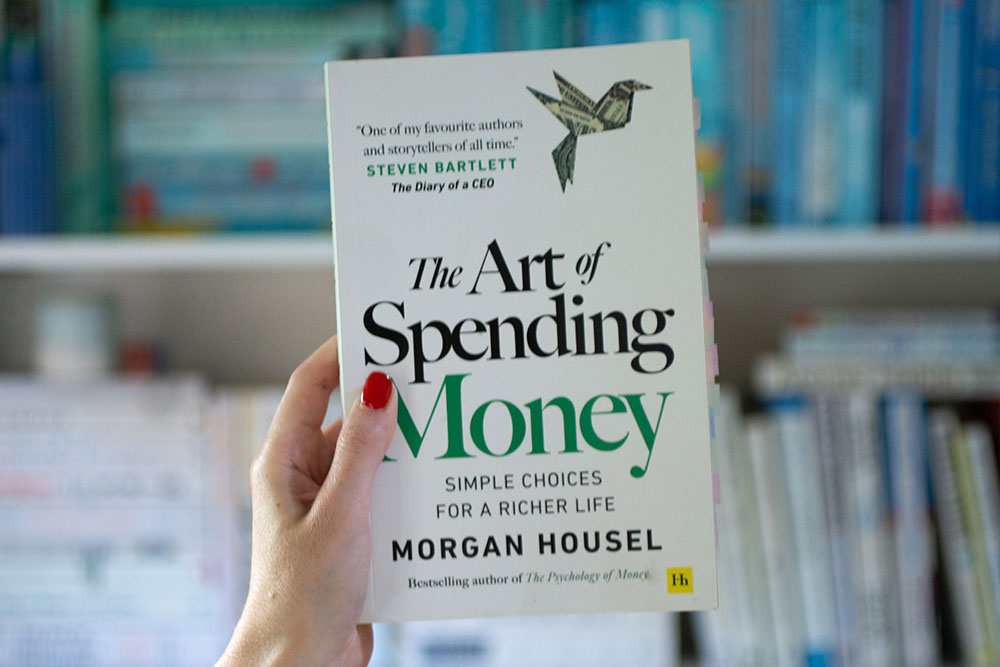
Let me reiterate the two ways to use money: One is as a tool to live a better life. The other is as a yardstick of success to measure yourself against other people. The first is quiet and personal, the second is loud and performative. It’s so obvious which leads to a happier life.
Page 158
In a nutshell

In The Art of Spending Money, Morgan Housel provides guidance on how to harness the power of money to live a happier life. He delves into aspects about money that most finance books miss, namely individuality, greed, jealousy, status, and regret. His practical approach to managing wealth and finding deeper meaning and contentment in life will transform your relationship with money.
Book Club Notes

I loved this book. It’s so brilliant, easy to read and highly taggable. If I could type out each tag I placed, I’d be reproducing most of this book.
Stripped down, there aren’t many ideas or insights I would call groundbreaking, some may be things you have heard or thought about before, albeit in a fleeting non-concrete way – but the profound way Housel puts it all together and brings it to life will blow your mind and spark inspiration for how you want to view and spend money.
The most immediately usable idea that I took away from this book is an idea he extrapolated on from Daniel Kahneman who once said that “an important part of becoming good with money is having a well-calibrated sense of your future regret.” If you can (accurately) figure out how your future self will feel about your decisions, it will change how you spend your money. It immediately changed mine.
That wasn’t the only idea that stuck with me. There were so many nuggets that gave me chills and inspired me. I can’t share them all, so simply put this book is an absolute must read, and if you’re still on the fence here’s a taster of what you can expect.
5 Ideas that Inspired me

When actual experiences create less joy than you anticipated, it’s often because the moment you acquire something new you immediately jump to desiring whatever else you don’t have.
Good memories are the closest thing to living for today while compounding for tomorrow.
The trick is viewing every bit of savings as having actively purchased something, even if it doesn’t come with a receipt: You have purchased the ability to do what you want, when you want, with whom you want, for as long as you want. And it is priceless.
Trading money for time, rather than trading it for stuff is probably the most overlooked aspect of spending money.
There’s no way to learn the value of money without feeling the power of its scarcity.
Read If

You want to spend money more wisely and are looking for a brilliant set of mantras to live your financial life by.

Rating
Writing – 10/10
Applicability – 10/10
Timelessness – 10/10
Shareability – 10/10
The Nitty Gritty

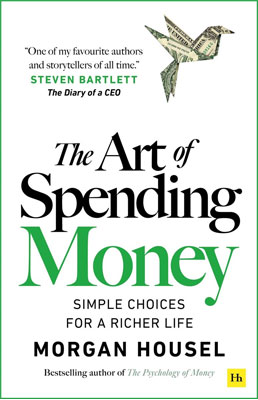
Published by: Harriman House, an imprint of Pan Macmillan
Genre:Non-Fiction, Self Help, Finance
ISBN: 978-1-80409-189-0
Pages: 240
Shop This: Takealot, Exclusive Books, Amazon Kindle
Similar Reads



A note on our book ratings
Readability: How easy is it to read and understand what the author is saying? Do you need a dictionary or PhD to understand it?
Writing: How well written is the book? Do you find yourself wowed by the writing or unimpressed?
Applicability: How applicable is this book to daily life? Is there enough advice and actions that are easy to start applying?
Timelessness: Is the content of the book timeless or is it something that in a few years won’t have relevance?
Shareability: How likely are you to share the book?