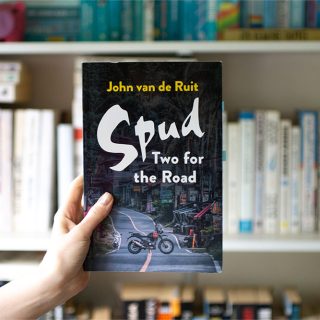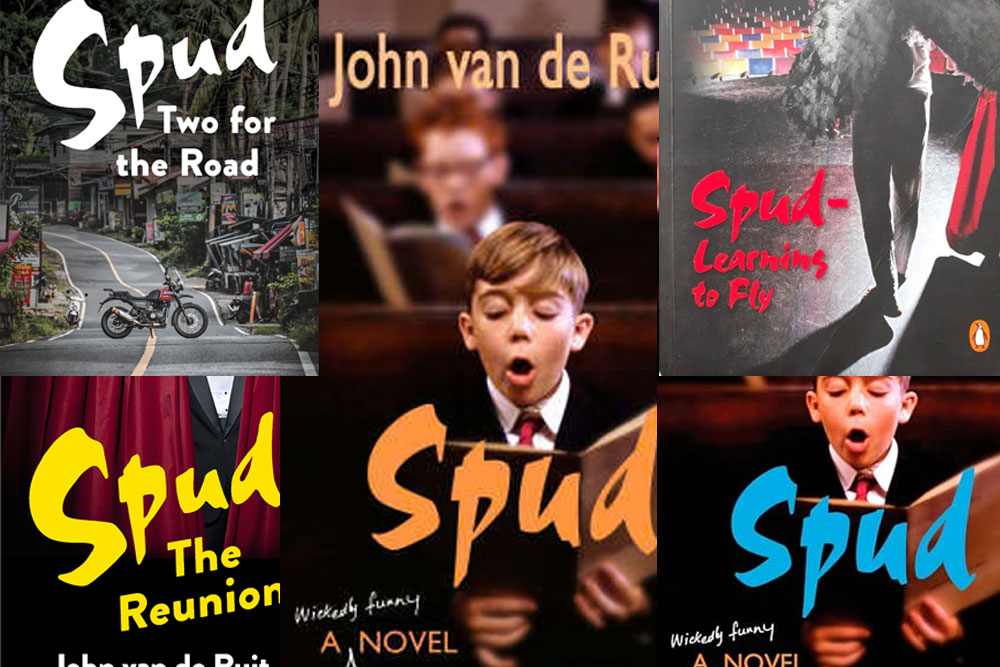
Coordinating my interview with John van de Ruit, the mastermind behind the Spud series, felt like coordinating an interview with Spud Milton. At the start of interview attempt #1 I sheepishly confessed that, for the first time, I was interviewing an author without having finished his book. When I told John where I was in the plot, he graciously offered to postpone the interview to the following week to allow me to finish it. A week later, attempt #2 was postponed again – John didn’t have power. And so it was that, three weeks after our initial interview, we finally met for a 45-minute chat about his latest (and final) book in the Spud series, Spud: Two for the Road.
The phenomenon that refuses to disappear
When John first sat down to write Spud over a decade ago, he wasn’t trying to create a cultural phenomenaon. In fact, he was hoping the book might sell between 3,000 and 5,000 copies. Being published at all felt like an enormous achievement, particularly when he considered the calibre of the other fiction being published at the time.
He’d already had a successful career in theatre, including acting and playwriting, but a novel felt like an entirely different beast. He was thrilled simply to have a book out in the world.
Then, before the book had even properly reached the shelves, his publisher told him it was going to reprint. John’s first reaction was bewilderment, “Nobody’s even bought it yet”.
It turned out that the bookshops were already ordering more copies. Something was happening, although John didn’t yet know quite how big it would become.
The momentum continued. He remembers being at the Cape Town Book Fair in 2006, signing books for a queue of readers that stretched out of the convention centre and around the block. Suddenly, he was travelling between cities, appearing at events and meeting crowds of people who wanted to talk about a boy he’d originally invented at his desk.
The book went on to become a series, then films, and eventually something that seemed to belong to readers as much as it belonged to its author.
John describes the experience of watching Spud grow as almost like having two careers running alongside each other. He was writing the books while navigating the demands of their growing success, including film adaptations, public appearances and the expectations that came with being the Spud guy.
It was exciting, but it was also exhausting. He’d effectively been on the road for years, first with theatre and then with Spud. After the fourth book, Spud: Exit, Pursued by a Bear, he needed to step back.
For a while, it seemed as though he’d said everything he had to say about the character.
But Spud, it turns out, wasn’t quite finished with him.
During COVID, when the world came to a standstill, John began reflecting on the period between 2000 and 2005. He realised there was still rich territory to explore, particularly when he considered what had happened to him and the people around him during those years.
There was another thing he couldn’t ignore: Spud had never really gone away.
John still regularly meets parents whose children have discovered the books. Sometimes those children have never been particularly interested in reading before, only to become completely absorbed in the series.
In a world where attention spans are shrinking and fads come and go in the blink of an eye, there’s something special about a fictional boy navigating boarding school, friendship, embarrassment and growing up who continues to capture the imaginations of new generations of readers.
And that, John realised, was reason enough to return.
Growing up with Spud
The two most recent books, Spud: The Reunion and Two for the Road, gave John an opportunity to revisit his characters from a different perspective.
The earlier books followed Spud through his school years. Returning to him as an adult allowed John to explore a new set of questions, including what happens when the people we once were, collide with the people we’ve become.
He was particularly interested in the idea of negotiating the idea of success and failure and the pressure of adulthood in The Reunion and Two for the Road.
John was 27 when he began writing the first Spud book, so returning to this period of his life also meant reflecting on his own twenties. He remembers the pressure of approaching 30, a time when it can feel as though everyone around you is making decisions about what their lives should look like.
At the time, many young South Africans were leaving for London and travelling through Europe. Staying in South Africa and pursuing a creative career meant choosing a different path from the one many of his peers were taking.
Looking back, he realised how much material there was in that period of uncertainty, ambition and figuring things out.
There was also something interesting about approaching Spud in the voice of an adult. The character had taken a few knocks along the way, and the reunion wasn’t necessarily the happy, uncomplicated return to the past he might have imagined.
Is this (really) the final Spud book?
If you’ve read Two for the Road, you’ll know that the ending brings things full circle in a way that feels both satisfying and a little unsettling.
I had my own moment when I reached the end and realised that Spud was, in a sense, writing Spud.
Without giving too much away, John explained that he deliberately brought Spud to the point where he’s writing his first book. He starts with a short story, which gets a little out of hand, and finds himself working with the Guv, who offers advice as he tries to figure out whether his writing might one day be published.
For John, this was particularly meaningful because it mirrored his own experience of beginning to write Spud. He remembers looking at books in a bookshop and wondering whether what he was creating was anything like the sort of thing publishers actually wanted.
There’s a strange overlap between the fictional character and the real author here, but John was clear that it was time to draw a line.
Seven or eight months after the events of Two for the Road conclude, John himself would launch the first Spud book. In other words, Spud’s fictional life was about to catch up with John’s real one.
Continuing the series beyond that point would mean exploring Spud as a published author, and John isn’t particularly interested in doing that.
He would rather explore a struggling writer than a successful one, unless that successful writer was about to spectacularly unravel. And even then, he joked, readers might assume he was writing about himself.
More importantly, he feels that the story has reached its natural conclusion. The books have travelled a long road, and he’s taken Spud as far as he needs to.
How much of Spud is actually John?
The question he gets most often, is Spud John? John admitted that there are similarities, but he was also quick to point out that they’re quite different people.
Their politics are similar, and both share a tendency to retreat into their own worlds before venturing back out into the mix. They also both enjoy writing and have a fondness for the camaraderie of a close-knit group of friends.
But the Crazy Eight are where the similarities become more complicated.
John’s own boarding-school experience was considerably less cosy than Spud’s. He described a more hostile environment, where friendships could involve being on the receiving end of jokes and banter, sometimes at your own expense.
He was careful to explain that the people he based some of the characters on weren’t necessarily his friends. In fact, some of the people who inspired those characters were among those he wouldn’t have considered friends at all.
John had spent time studying masculinity, including how private boys’ boarding schools shape young men and encourage them to fit into recognisable archetypes. He was interested in the ways boys and men use humour to make sense of one another, sometimes reducing complex people to a handful of characteristics because it’s easier than sitting with that complexity.
He also wanted to explore the particular world of white South African life during the 1980s and 1990s, as the country moved from apartheid towards democracy.
Rather than presenting boarding school as a uniformly brutal, humourless institution, he wanted to find satire in it.
The Crazy Eight, with all their ridiculousness and larger-than-life personalities, helped him do exactly that.
They give the series its fictional crackle, as John put it, preventing the stories from becoming too close to memoir.
His editor even had to remind him at times that certain passages were becoming a little too autobiographical.
The solution? Let the characters take over.
John also draws on people he knows when creating characters. His father, for example, was a character in his own right, although not quite as cartoonish as Spud’s dad.
Spud himself, John believes, is in some ways a deeper human being than he is. Writing the character allows him to explore parts of himself that don’t necessarily come naturally in everyday life.
And while John might prefer putting things into neat, funny boxes, Spud is more comfortable wandering into the complicated, reflective territory.
Writing like an actor
Perhaps one of the most interesting things I learnt during our conversation was that John still approaches writing like an actor.
Before Spud, he’d spent years performing on stage. He understood what it meant to inhabit a character, to find their voice and to work out how they moved, spoke and responded to the world around them.
That experience hasn’t disappeared simply because he’s swapped scripts for novels.
When John writes Spud, he can hear the character’s voice. He knows the tone, the pacing, the pauses and the way he would articulate a particular thought.
The same applies to the other characters. He has a sense of their individual voices, which helps him write their dialogue.
He even describes experiencing a physical response when he gets into Spud’s character, rather like the physical habits an actor might develop to help them inhabit a role.
His writing process involves planning, but he doesn’t want to control every word. He works from a rough outline, then allows the character to articulate the story as he writes.
He compared himself to a pilot in a plane: he’s directing Spud towards the next destination, but he doesn’t need to control every little movement along the way.
It’s an approach that makes sense when you consider how much personality there is in the books. The characters don’t simply exist to move the plot forward. They feel like people who would continue being themselves even if the reader weren’t watching.
What’s next for John van de Ruit?
Having spent so much of his creative life with Spud, what comes next?
Write another series? Start an entirely different project? Or take a complete career pivot?
John was open to all of those possibilities, although he doesn’t have a straightforward answer.
He is working on something, but it isn’t necessarily a novel. It might eventually become one. What he does know is that he doesn’t want to write a book simply for the sake of publishing one.
Whatever comes next needs to be something that hooks him, something with the potential to have a real impact and that makes him want to spend 18 months alone in a room developing characters and building a world.
He’s less interested in the idea of producing a new book every two years just because that’s what authors are supposed to do.
Instead, he wants to let the next project emerge organically. He’ll work on different ideas, share them with people whose opinions he values, and see what develops.