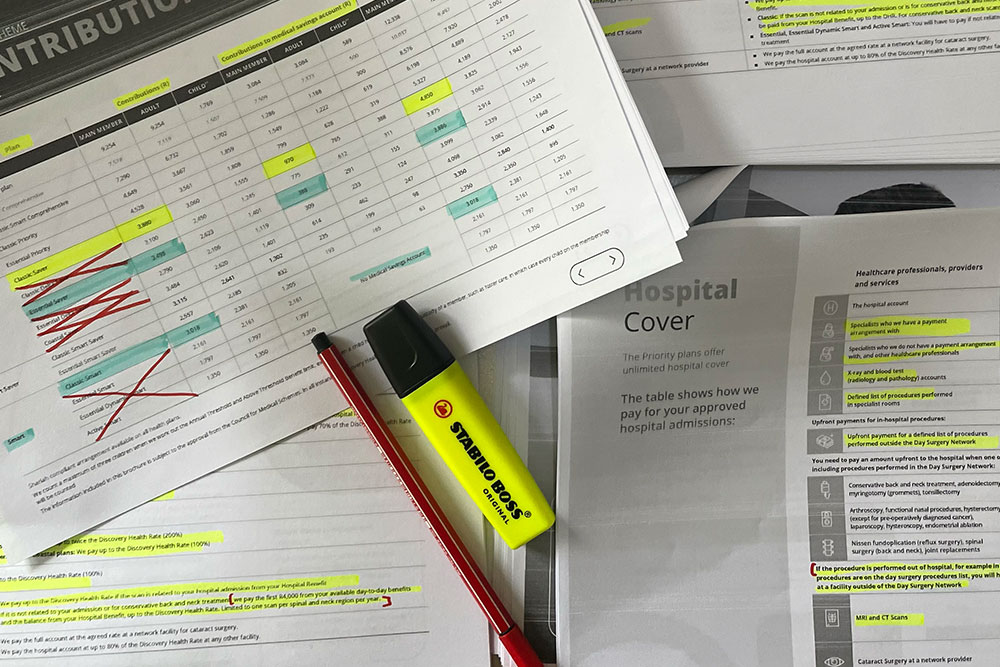
Every December I spend hours looking over Discovery’s Medical Aid Plans, reading the fine print, reviewing the benefits, noting the changes, and then deciding which plan makes the most sense for me and my family.
It might be too late to make changes to your 2026 plan, but it’s never too late to understand the differences in benefits that each plan offers. Based on conversations I’ve had and discussions I’ve seen online, there is a misconception about how medical aid plans work and what they actually give you. So in simple, plain English, here’s how I group four of Discovery’s broad plan levels.
Core: hospital-only
Smart: hospital cover with limited day-to-day benefits (no savings account)
Saver: hospital cover with a medical savings account
Priority: hospital cover with a medical savings account and an above-threshold benefit
For all these plans:
Essential means they will cover in-hospital treatment at 100% of the Discovery Health Rate (DHR) for specialists they don’t have a tariff agreement with. Where a provider has an agreement and all rules are met (such as authorisation and using designated service providers), they will generally cover in full.
Classic means they will cover in-hospital treatment at 200% of the DHR for specialists they don’t have a tariff agreement with. Where a provider has an agreement and all plan rules are met, they will generally cover in full.
If a plan has Delta or Smart in the name, you are limited to a specific hospital network. If you choose a hospital outside of that network, you may be liable for a co-payment or reduced cover. The amount and structure of this penalty differ per plan and admission type.
Core plans are great for solid hospital and emergency coverage.
Smart plans can offer more value than a pure hospital plan for some people, as they include limited day-to-day benefits without a medical savings account. However, there are exclusions and limitations in both day-to-day and in-hospital cover, so it’s important to read the fine print carefully and understand exactly what is and isn’t covered.
Saver plans generally offer similar hospital cover to Core plans, with the addition of a medical savings account. It’s important to note that this savings amount is funded by your own monthly contributions. Once the savings are depleted, you will pay for most non-hospital, non-PMB day-to-day medical expenses yourself.
Priority plans offer hospital cover similar to Saver plans (with some differences in co-payments for procedures such as scopes, so the fine print matters). You also receive a medical savings account, which is larger than on Saver plans and funded by higher monthly contributions. Once the savings are depleted, you will still pay for most non-hospital day-to-day medical expenses yourself.
Priority plans also include an above-threshold benefit, which means that after your medical savings are used up and you have paid a defined amount out of pocket, the scheme may start paying again, up to a specified limit. Not all expenses qualify toward reaching this threshold, so it’s important to understand which costs count and to have a realistic view of your annual medical spend to determine whether this benefit is worthwhile for you.
The value you get from your plan is obviously dependent on the scheme and plan type, and I haven’t studied every option available. Based on my research and experience, I view medical aid primarily as insurance for emergencies, not as a product that reliably delivers day-to-day value. Much like car insurance, you pay for protection and hope you don’t need to use it. Most of the day-to-day “value” in higher-tier plans comes from money you are contributing to a savings pocket yourself, rather than from an additional benefit.
Please keep in mind that I am not a financial advisor; this is purely my understanding of how these plans work. I strongly recommend doing your own research and always reading the fine print. If you do wish to use a financial advisor, this is a helpful resource on how to choose one.